

Guide
Follow-up messages for customers who stopped replying: WhatsApp templates for every stage
A customer asked for your price and went quiet? See when to get back in touch, what to write at each stage and how to automate follow-up without sounding like a bot.
By Bruno Porto6 min read
Why do customers go quiet on WhatsApp?
Most of the time, it is not a lack of interest. The person got interrupted, wanted to think about it, found the price high and did not say so, or got stuck at a step such as payment. Follow-up is about finding out which it was and removing the obstacle.
- Got distracted: the message was left for later and buried under other chats.
- Has a question: about price, timing or how it works, and did not ask.
- Is comparing: asked several businesses for a quote.
- Got stuck at payment: the link failed or was left for "later".
When should you send a follow-up message?
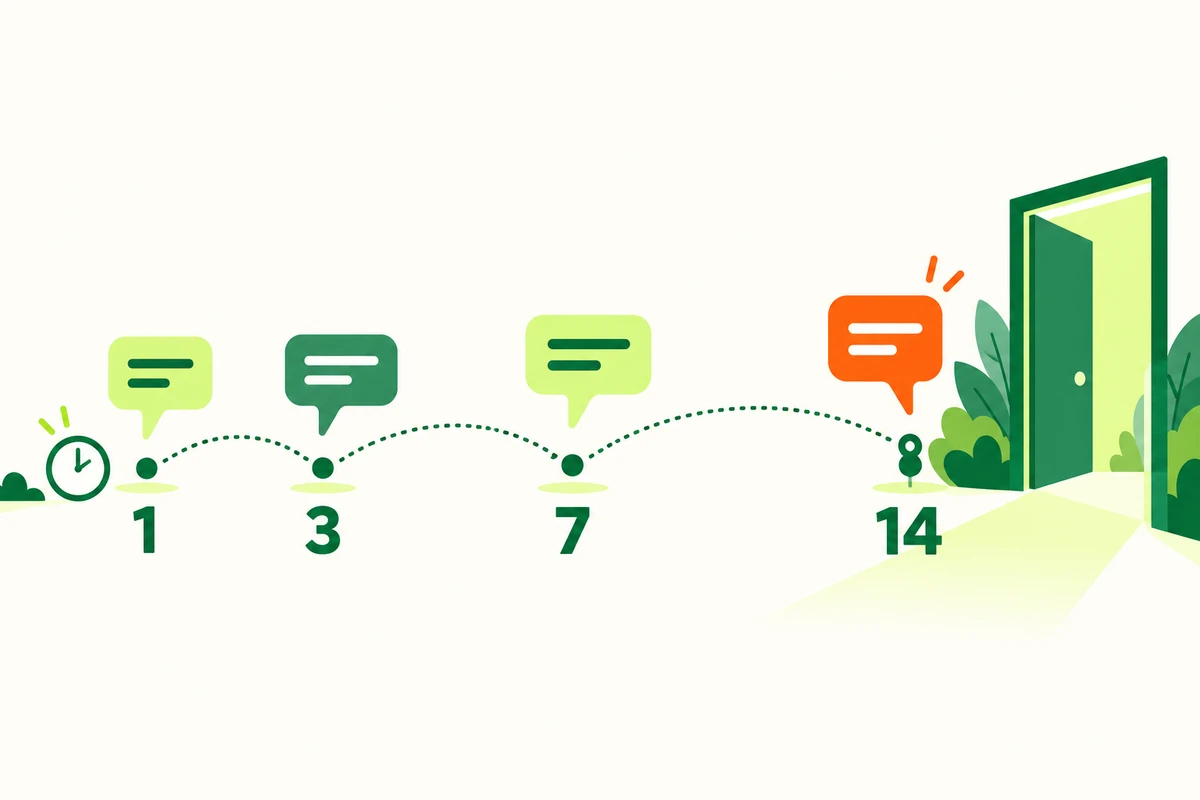
A simple cadence works for most service businesses: the first message after one day, the second two days later, the third after four days and the last after a week. Adjust it to your sales rhythm.
| Attempt | When | Goal |
|---|---|---|
| 1st | About 24 hours without a reply | Pick up where the conversation stopped |
| 2nd | +2 days | Answer a likely question |
| 3rd | +4 days | Bring a new reason: a free slot, an offer, something new |
| 4th | +7 days | Sign off politely and leave the door open |
How often are customers happy to hear from you?
Less often than many businesses think. In the Opinion Box survey, the most common ideal frequency for messages from businesses was once a week. That is why follow-up should be spaced out and useful, not daily.
- 33%of WhatsApp users in Brazil say once a week is the ideal frequency for messages from businesses.Opinion Box, WhatsApp no Brasil 2026
- 58%have bought products on WhatsApp more than once.Opinion Box, WhatsApp no Brasil 2026
The second figure shows the other side: people who buy on WhatsApp buy again. Good follow-up is not just about closing the first sale, but about keeping the conversation open for the next ones.
What message should you send at each stage?
The best message continues the conversation where it stopped. Use the person’s name, mention what they asked for and ask a question that is easy to answer. Replace the text in brackets.
Sent a message and did not continue
- Hi [name]! I saw you got in touch and we didn’t get a chance to talk. Can I help with anything?
- Hi [name]! Any questions about [service]? If you like, I can send you this week’s free slots now.
Got the price and went quiet
- Hi [name]! Did you get a chance to look at the price for [service]? Happy to explain what’s included.
- Hi [name]! I still have [day] at [time] free for [service]. Shall I book it for you?
Was negotiating
- Hi [name]! Had a chance to think about what we discussed? If you want to adjust anything, just let me know.
- Hi [name]! Just a heads-up: the terms we discussed are valid until [date]. Shall I go ahead?
Was going to pay
- Hi [name]! I noticed the payment hasn’t come through yet. Did the link give you any trouble? I can send another now.
- Hi [name]! Your appointment on [day] is still on hold. To confirm it, here’s the payment link: [link].
Last attempt
- Hi [name]! I don’t want to bother you, so this is my last message about [service]. Whenever you’re ready, just message me here.
Which mistakes make customers disappear for good?
The most common mistakes are demanding a reply, sending the same generic message to everyone and insisting non-stop. Good follow-up feels like the conversation continuing, not a mass broadcast.
Do
- Use their name and mention what they asked for.
- Ask a question that is easy to answer.
- Bring something new with each attempt.
- Stick to business hours.
Avoid
- "Hello?? Do you want it or not?"
- Copying and pasting the same text into every chat.
- Sending several messages on the same day.
- Offering a discount on the first attempt (it teaches customers to go quiet).
Can you automate follow-up on WhatsApp?
Yes. What matters is the right message for the right stage at the right time, and stopping as soon as the customer replies. Doing that by hand across dozens of conversations is what usually breaks down.
- AI agent
A haircut with a beard trim is $25 and takes about 50 minutes.
- Customer
Let me check and get back to you.
- AI agent
Hi Rafael! I still have tomorrow at 6 pm free for a haircut and beard trim. Shall I book it for you?
- Customer
Book it!
Frequently asked questions
- How many times should I message a customer who stopped replying?
- Three or four spaced-out attempts are usually enough. After that, sign off politely and make it clear they can message you any time.
- How long should I wait before the first follow-up?
- One day without a reply is a good starting point for service businesses. If the customer asked for time, respect it.
- Is following up annoying?
- Not if the message is useful: mentioning a free slot, answering a question or making payment easier. What is annoying is demanding a reply or repeating the same text.
- Does automatic follow-up stop when the customer replies?
- With Caji, yes: when the lead replies, the conversation carries on normally and the next attempts are not sent.
Sources
No customer forgotten on WhatsApp
Try Caji free for 7 days, no credit card, and watch the agent win back people who stopped replying.
Try it free for 7 days

Keep reading
Guide
WhatsApp payment reminder messages: polite templates for every stage
Ready-made messages to remind, chase and renegotiate payments on WhatsApp without losing the customer, plus legal points to watch and how to make paying easy.
6 min read

Guide
WhatsApp Business auto reply: how to set it up, plus ready-to-copy templates
Step by step for greeting messages, away messages and quick replies, with templates to copy and paste, and what to do when that is no longer enough.
7 min read